
I’ve spent a lot of time testing crash games, and Aviator slots online is still the slot Peruvian players ask me about most when they want to move past standard slots. The name says slot, but what you actually receive is a real-time multiplier game where a small airplane rises across the screen and your payout expands with every fraction of a second you keep in the round. Testing before you wager matters because it lets you internalize the rhythm, test cashout reflexes, and grasp the math without endangering a single sol. In this guide I will guide you through every concrete detail that counts: how the crash mechanic works, what RTP and volatility really mean inside Aviator, the exact betting tools you have, and how to use the free demo mode to develop a practical feel before you commit real money. Everything I explain is based on the standard Spribe version of the game that leads the Peruvian market, and I will highlight where you should verify specifics on the platform you choose.
What Distinguishes Aviator Different from Traditional Slots
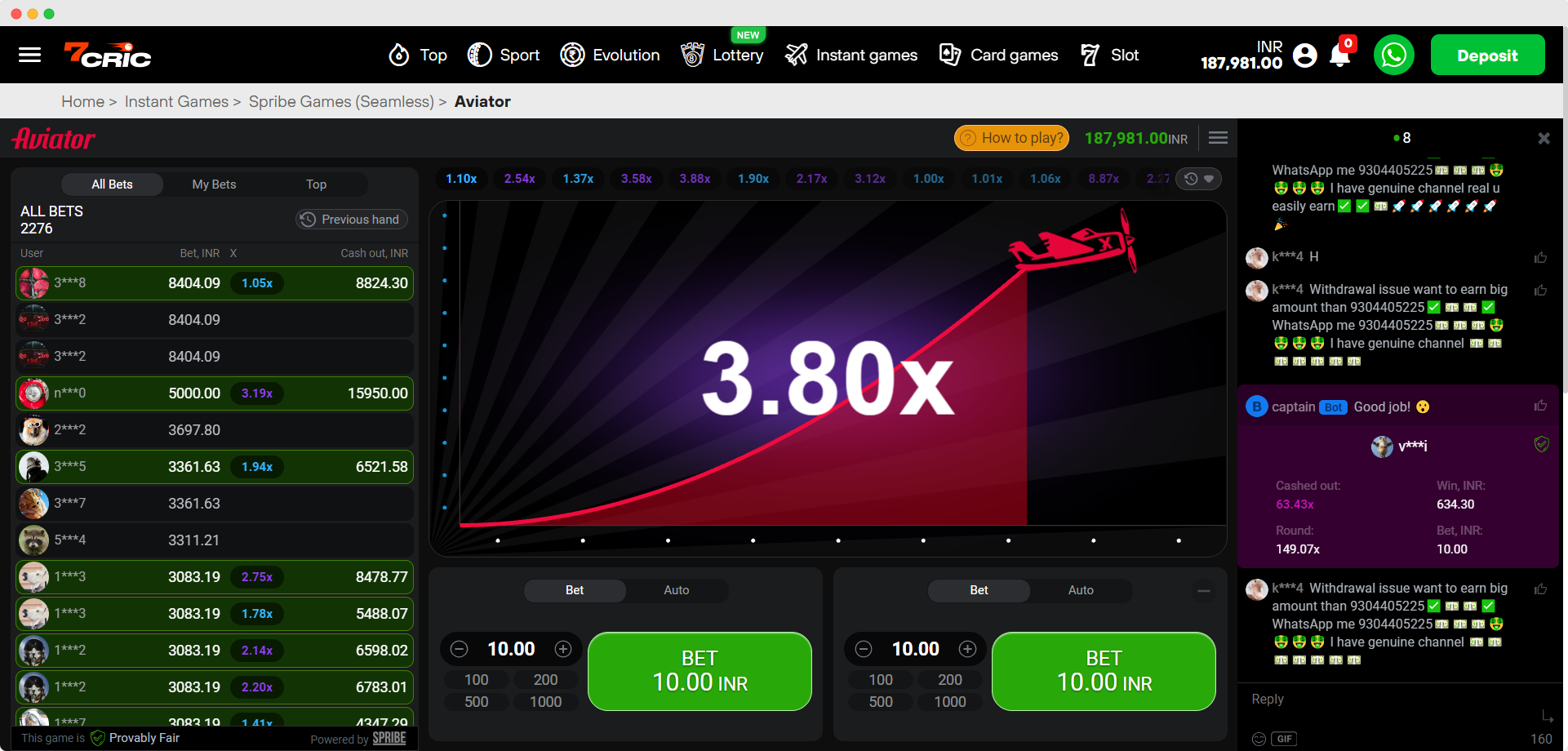
If you come to Aviator looking for reels, paylines, or scatter symbols, you might be confused during the first second. This is not a slot in the classic sense. The screen displays a black background with a graph grid, a red airplane taking off from the left, and a multiplier counter that initiates at 1.00x and climbs. Your only decision is when to cash out. There are no spinning reels, no wilds, no free spin triggers, and no bonus rounds hidden behind three scatters. That fundamental difference changes how you manage bankroll management and session rhythm. Because every round lasts anywhere from a few seconds to a rare minute or more, you are not anticipating a feature to land. You are actively deciding the outcome of each bet.
The absence of paylines also means there is no paytable as you might expect. Your win is simply your stake multiplied by the number showing on the screen at the instant you cash out. If you bet 5 PEN and hit cashout at 2.34x, you walk away with 11.70 PEN. If you wait too long and the plane flies away, you lose the entire stake. This direct relationship between timing and payout is what makes Aviator resemble a trading or reflex game than a slot. For Peruvian players familiar with video bingo or classic three-reel machines, the mental shift is significant, and that is exactly why a demo session is useful before you put money down.
Another key difference is social transparency. The interface reveals recent rounds from other players, their cashout multipliers, and the total amounts won. You can see that someone just turned 2 PEN into 20 PEN at 10x, while another player lost because they held too long. That shared data feed creates a sense of collective experience you never get on a solitary slot machine. It also gives you real historical information you can analyze during demo play to understand multiplier distribution patterns, even though each round is independently generated.
Wagering Choices, Boundaries, and the Two-Bet Feature
When you launch the betting panel in Aviator, you will find two individual bet fields titled Bet 1 and Bet 2. This double bet system is one of the most effective tools the game presents, and it is fully available in demo mode. You can set a single bet in one field and make the other empty, or you can fill both together with various amounts and, crucially, distinct cashout strategies. For example, I often experiment with a configuration where Bet 1 is a moderate amount set to auto cashout at 1.50x, while Bet 2 is a lower, riskier wager that I manually control and attempt to take to a larger multiplier. This allows you to hedge within a single round, securing a modest profit on one side while still maintaining exposure to a bigger payout on the other.
The minimum and maximum bet limits differ depending on the online platform that offers the game, but typical ranges I have seen in Peru begin as low as 0.10 PEN and go up to about 400 PEN per bet field. Some platforms may set greater ceilings for high rollers. The demo version typically provides a ample virtual balance that allows you to try the full range without restriction. I advise using the demo to observe how the interface manages rapid bet placement between rounds, because the countdown timer between takeoffs is short, usually around five seconds. You must to be able to adjust your stake, switch auto cashout values, and set both bet fields quickly, and practicing this flow with play money develops the muscle memory that avoids misclicks when real funds are on the line.
Two-Bet Strategy
Using both bet fields effectively requires a definite plan. One common approach I notice among seasoned players is to set Bet 1 three to five times bigger than Bet 2. Bet 1 gets an aggressive auto cashout at a low multiplier like 1.30x to 1.80x, intending to compensate for the total round stake and produce a small net gain most of the time. Bet 2 is left on manual or configured to a much higher auto cashout, such as 10x or 20x, and regarded as a lottery ticket that occasionally pays large. In demo mode, you can test this split across a hundred rounds and see how regularly the conservative side protects the round when the risky side fails. The numbers will show you more about risk management than any article can.
Visual Style and Visual Atmosphere
Aviator relies on a minimalist aviation theme that does not distract from the numbers. The color palette is dominated by deep black, neon red, and white grid lines that look like a radar screen or a stock chart. The airplane itself is a simple red silhouette with a subtle vapor trail, and the multiplier curve renders in real time as a white line that ascends and eventually ends abruptly when the round crashes. There are no animated characters, no cinematic cutscenes, and no thematic soundtracks layered with orchestral swells. Instead, you experience a low electronic hum and a ticking sound that accelerates as the multiplier climbs. I find that does more for tension than any elaborate theme could.
This minimalist design is deliberate. Spribe created Aviator to work smoothly on mobile devices with weak connections, which carries significant weight in Peru where many players use games on mid-range Android phones and sometimes rely on mobile data. The interface loads quickly, the plane animation is efficient, and the betting panel keeps working even when the multiplier is rising quickly. The visual focus remains on the growing number and the cashout button, which shines green and throbs lightly to signal you that you can leave at any moment. There is no clutter, no pop-up advertising for other games, and no confusing menu structure overlaying the play area.
For a Peruvian audience playing Aviator for the first time, the atmosphere can feel cold compared to the bright, festive graphics of a standard Latin American-themed slot. I personally view that as an benefit. The absence of sensory overload allows you focus on the single skill this game measures: your ability to evaluate the situation and respond decisively. The demo mode preserves every visual and audio element just as they show up in real-money play, so you can get used to the pressure of the ticking sound and the flashing multiplier without financial consequences.
Multiplier values, Max Win Potential, and Payout formulas
Aviator does not feature a fixed jackpot, but the maximum multiplier is theoretically set at an extremely high value, often around 1,000,000x in the Spribe version. In real terms, multipliers above 1,000x are incredibly rare, and most sessions will see a peak somewhere between 10x and 200x over several hours of play. Your payout is always a straightforward multiplication: stake times cashout multiplier. If you bet 10 PEN and exit at 15.50x, you receive 155 PEN. There are no fees, no bonus round adjustments, and no maximum win limit imposed by the game itself, though individual casino platforms may set their own caps on total payout per round.
The max win potential is consequently limited only by the multiplier ceiling and the size of your bet. However, chasing a 1,000x multiplier with a large stake is a sure way to deplete a bankroll because the probability of a round reaching that height is infinitesimal. In demo mode, you can simulate what happens if you set a 50 PEN bet and target 500x. You will likely watch your virtual balance disappear over dozens of rounds before you hit anything close. That experience is eye-opening and highly educational. I believe every player in Peru should run that same simulation with play money before ever considering a high-multiplier strategy with real funds, because seeing the balance drop on screen teaches risk in a way that reading about probabilities never can.
Payout calculations become somewhat more interesting when you use the double bet feature. Suppose you place 5 PEN on Bet 1 with auto cashout at 2.00x and 2 PEN on Bet 2 with manual cashout. If the round reaches 2.00x and you manually exit Bet 2 at 4.50x, your total return is (5 × 2) + (2 × 4.50) = 10 + 9 = 19 PEN on a total stake of 7 PEN. If the round crashes at 1.80x, you lose both bets. The demo mode lets you run dozens of these split scenarios and calculate the net result, which is the best way to find a configuration that fits your personal profit target and loss tolerance.
Auto Cashout and Hands-On Management: Setting Your Departure
The auto cashout feature acts as the tool that converts Aviator from a pure reflex game into a structured strategy exercise. Before each round begins, you can input a target multiplier into the auto cashout field, and the game will instantly exit your bet at that exact value if the round continues that long. This takes away the emotional component of watching the number rise and questioning yourself. I have found that setting an auto cashout is the single most effective way to adhere to a predetermined plan, especially during demo sessions where the temptation to let it ride just one more time is powerful even with fake money.
Manual cashout, on the other hand, provides you complete control. You watch the multiplier climb and tap the glowing cashout button whenever you decide. The risk here is delay. The human brain is wired to hold on a little longer when a number is rising quickly, and that delay is exactly what causes crashes with zero return. During free play, I deliberately practice manual cashout at odd multipliers like 2.35x or 3.70x to train myself to act on a pre-chosen number rather than reacting to the curve. You can also combine manual and auto modes by setting a high auto cashout as a safety net while attempting to exit manually at a lower target, though this needs quick fingers and a calm mind.
Choosing Your Auto Cashout Value
Choosing the right auto cashout number is a personal decision that relies on your risk tolerance and session goals. A value of 1.20x will succeed in roughly four out of five rounds based on the game’s crash distribution, giving you frequent small wins that can slowly grow a balance. A setting of 3.00x succeeds far less often but triples your stake when it hits. I recommend using the demo mode’s statistics panel to review the last 200 or 300 rounds and count how many times each multiplier threshold was reached. That exercise gives you a realistic sense of the waiting periods you will endure between wins at different levels, which is invaluable for setting expectations before you play with real Peruvian soles.
Comprehending RTP and Volatility in Aviator
The calculated return to player for Aviator is 97%, which positions it in the comparable range as many high-RTP slots and table games. That number indicates the long-term expected payback across millions of rounds, and it relies on optimal player decisions. In practice, your personal return hinges completely on when you opt to cash out. If you always exit at very low multipliers, you will capture a high hit frequency but small average wins, and your effective RTP will approximate the theoretical number over time. If you go after large multipliers and frequently crash with zero, your short-term results will be far more unpredictable and your realized return can fluctuate wildly below or above 97%.
Volatility in Aviator is not a fixed parameter like it is in a slot where the paytable and hit frequency are mathematically fixed. Instead, volatility is player-driven. You can configure the game to function like a low-volatility session by setting an auto cashout at 1.20x and placing small bets, or you can turn it into an extreme high-volatility round by targeting 50x and understanding that you will lose many rounds in a row. This adaptability is rare and is one of the aspects I find Aviator so valuable for bankroll education. During demo play, I recommend experimenting with both extremes so you can experience the emotional distinction between grinding out tiny consistent gains and withstanding long dry spells while seeking a monster multiplier.
For Peruvian players who are used to fixed-volatility slots where the game controls the variance, this adjustable nature can be disorienting at first. The demo mode is the perfect sandbox to identify your own comfort zone. You might discover that you detest the stress of watching the multiplier climb past 3x, or you might realize that cashing out at 1.15x wearies you to tears. Neither inclination is wrong, but recognizing it before you switch to real money stops costly emotional mistakes. I always advise spending at least a hundred demo rounds testing different cashout thresholds while monitoring your virtual balance to see which strategy matches with your temperament.
The way the Crash Mechanic Really Works
The heart of Aviator is a provably fair random number generator that establishes a secret crash point before the round even begins. When you make your bet and the countdown hits zero, the multiplier begins at 1.00x and increases along a predetermined curve. The round proceeds until it arrives at that hidden crash point, at which moment the plane flies off the screen and all active bets that have not been cashed out are lost. The multiplier can fail at 1.01x, at 2.50x, at 100x, or at any value in between, and the distribution is weighted so that low crashes occur far more commonly than high ones.
Understanding that the crash point is fixed before takeoff is crucial because it removes the illusion that you can feel when the round is about to end. The accelerating ticking sound and the steepening curve do not suggest an impending crash. They are purely visual. I have viewed hundreds of rounds in demo mode, and I can state that a round that attains 5x is no more likely to crash at 5.10x than a round that just went past 1.20x. The game’s mathematics are without memory, meaning each new round is completely independent of the previous one. This is the single most important concept to internalize during free play, because it guards you from the gambler’s fallacy that a high multiplier is overdue after a streak of low crashes.
The Curve of Multipliers and Crash Point Generation
The multiplier does not grow linearly. It goes up slowly at first, then gains pace. The formula uses an exponential growth function that makes the early seconds feel secure while the later stages become visually intense. This design choice is mental: it encourages you to stay in the round a little longer because the number is climbing faster and the potential reward appears to explode. In reality, the probability of the round lasting to any given multiplier decreases sharply as the number grows. The house edge is integrated in the gap between the true odds of achieving a multiplier and the payout you receive when you cash out.
Cryptographically Fair Verification
Every round in Aviator can be independently verified using cryptographic hashes. The game merges a server seed, a client seed, and a nonce to produce the crash point, and after the round ends you can check the hash to confirm that the outcome was not manipulated. During demo play, you will often spot a Provably Fair icon that lets you retrieve the seeds. I suggest taking a few minutes to go through a verification exercise with a free round, because understanding this mechanism builds genuine trust in the game’s integrity before you ever add money to your account.
How to Experience Aviator for Free: The Demo Mode Advantage
Nearly every online platform that provides Aviator to Peruvian players offers a demo or fun play version that requires no registration and no deposit. You simply navigate to the game, and if a real-money balance is not detected, the interface often loads a virtual balance of several thousand units. The demo mode is identical to the real-money game in every functional respect: the same crash mechanics, the same betting panel, the same double bet fields, the same auto cashout settings, and the same provably fair verification tools. The only difference is that your wins and losses do not affect your wallet.
I consider the demo mode the most underused educational tool in online gaming. It allows you test specific hypotheses about the game without financial pressure. You can ask questions like what happens if I always cash out at 1.15x for 200 rounds, and then actually run the experiment and count the results. You can train the physical motion of placing two bets and setting two different auto cashout values within a five-second countdown until it becomes automatic. You can also examine the game’s rhythm at different times of day, although the random number generator does not care about the clock. The demo mode is especially valuable in Peru because internet speeds can vary, and you want to know how the game performs on your connection before you have money at stake.
Getting to the Demo Mode in Peru
To start a free Aviator session, you typically go to the game page on a casino website or a review portal that hosts the official Spribe embed. If you already have an account, find a Demo or Play for Fun button near the real-money launch option. If you are not logged in, the game often loads directly in demo mode. I recommend using a desktop browser for your first few sessions because the larger screen makes it easier to read the multiplier and click the cashout button accurately. Once you are comfortable, move to your mobile device and test the touch interface, because many Peruvian players prefer to play on smartphones. The demo mode on mobile maintains the same layout, but the cashout button is positioned near the bottom of the screen where your thumb naturally rests, and you will want to verify that you can tap it without accidentally triggering a bet adjustment.
Practical Tips for Testing Before You Play in Peru
My first piece of advice is to approach the demo balance as if it were real money from the very first round. It is common to develop reckless habits when there are no consequences, and those habits can transfer directly to real-money play if you are not careful. Define a virtual session budget, say 500 PEN in demo funds, and decide in advance that you will stop when it runs out or when you double it. This approach forces you to make the same calculations about bet sizing and cashout timing that you will need later. I also suggest keeping a simple notepad next to you and jotting down the outcome of each round for at least 50 spins, noting the multiplier at which you cashed out and whether the round crashed before or after your exit. The pattern that emerges will tell you more about your own tendencies than any generic strategy guide.
Additionally, use the demo mode to try the extremes of the game’s bet range. Place the minimum allowed bet and see how the interface responds. Then set the maximum and observe whether the game slows down or the cashout button becomes harder to press under pressure. Some platforms may impose a slight delay on large cashouts, and you want to discover that in demo mode, not when you have 200 PEN riding on a 3x multiplier. Also experiment with the double bet feature extensively. Explore configurations where both bets have auto cashout, where one is manual and one is auto, and where both are manual. The coordination required for two manual cashouts is substantial, and you should know whether you can handle it before real money enters the picture.
Finally, pay attention to the social feed and the statistics panel during your free sessions. The game presents a history of recent multipliers, often colour-coded to show low, medium, and high results. While past rounds do not predict future ones, studying the distribution helps you internalize how often crashes occur at 1.00x to 1.50x compared to 5.00x and above. This knowledge moderates unrealistic expectations. I also recommend paying attention to how you feel emotionally after a streak of five consecutive crashes versus a streak of five wins. If the losses make you want to increase your virtual bet size dramatically, that is a red flag you can address before real money amplifies the impulse. Aviator rewards patience and clear-headed decision-making, and the try-before-you-bet approach gives you the space to develop both qualities without cost.